Working with the West
Making professional judgement visible across Western-influenced systems.
Capability can be present. Its value can still be missed.
Many leaders have exactly the judgement their organisation needs, yet colleagues, clients or headquarters still miss it, because the system expects it to be expressed differently. A careful warning is heard as agreement. A respectful pause is read as a lack of ownership.
This 120-minute executive briefing is for leaders and teams in Asia, Africa, the Middle East and Latin America, and for global teams, working with Western colleagues, clients, headquarters and decision systems. It is not a course in “being Western”. It shows where judgement gets lost, and how to make it count.
120 minutes · Live online · Private to your organisation · Up to 25 attendees · Chatham House Rule
US$3,000 · One fixed fee. No per-person charge.
Working with the West can look easier than it is
English is widely used. The meetings feel familiar. Everyone seems to share the same objectives, deadlines and commercial pressures. That familiarity can create false confidence.
A professional sees a serious risk, and describes it carefully. They disagree, but without a direct objection. They wait to be invited before giving a recommendation. They expect others to understand what was implied.
In many organisations shaped by Western working norms, what is not said clearly may be treated as if it does not exist. Restraint can be read as agreement. Qualification can be heard as uncertainty. The judgement was there. The decision never saw it.
There is no single West: American, British, German, French, Dutch and Nordic workplaces differ too. The briefing looks at the system around the person, not just their passport.
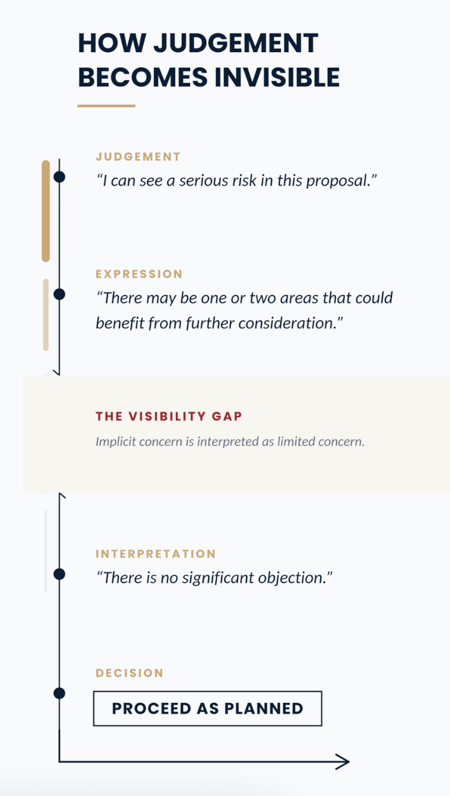
WHEN SILENCE LOOKS LIKE AGREEMENT - ILLUSTRATIVE SCENARIO
Nobody objected. So the decision moved forward.
A senior leader presented a new direction and invited questions. Nobody openly challenged it. The meeting ended with apparent alignment.
Several people in the room had seen serious weaknesses. Some believed they had already signalled their concerns. Others felt that challenging the proposal in public would be too early, disrespectful or pointless.
The decision-makers read the silence differently: no objection meant the plan had support, and everyone was committed to delivering it.
When the concerns finally surfaced, they were treated as late resistance, not as the professional judgement that had been there from the start.
The risk was visible to the team. It was invisible to the decision.
What Working with the West prepares you for
Five operating demands, and the practical tools to meet them.

CREATE CLARITY
Put the point, the decision and the ask where readers expect them, so colleagues and headquarters never have to guess what you mean or what should happen next.

CHALLENGE & INFLUENCE
Raise disagreement in a way that improves the decision. Build recommendations in the order decision-makers need, so your view shapes the outcome instead of being noted.

SHOW OWNERSHIP
Make initiative, accountability and decision boundaries visible without exceeding the authority your role actually carries.

ESCALATE RISK
Raise a developing risk while there are still options. Bring the evidence, the likely impact, a recommended action and a clear ask for the next decision.
Working with the West
-
Inside the 120 minutes
-
Language that works
-
Who is it for?
-
Format
Inside the 120 minutes
Two 55-minute parts, a 10-minute break, and one connected route.
Live and facilitated online. Executive cases, short exercises and practical language, applied to participants’ own work.
Part 1
- Opening. Find where expectations differ: culture, organisation and work system.
- Clarity. Find the point, decision and ask that should not stay unsaid.
- Challenge. Make serious disagreement clear enough to examine and use.
- Influence. Build a recommendation in the order the decision-maker needs.
Part 2 (after a 10-minute break)
5. Ownership. Define the outcome, the authority, the dependencies and visible progress.
6. Escalation. Raise a developing risk before the options disappear.
7. Together. Work through one cross-border case that connects all five demands.
Language that works
Small changes in wording that change what happens next.
From the briefing:
“Please advise.” → “Can you approve the change by Thursday?”
Names the decision and the date.
“FYI — see below.” → “Decision needed by Friday: …”
Puts the ask in the first line.
“Is that clear?” → “What will you do first?”
Checks that the understanding is shared.
Plain, idiom-free and useful in any direction, not only with Western colleagues.
Who is it for?
For organisations whose people work with Western-influenced organisations, clients, standards or institutions.
- Executives in Asia, Africa, the Middle East and Latin America working with Western counterparts
- Global and regional leaders balancing headquarters and country-team expectations
- Client, supplier and partnership teams in international work
- Government, multilateral, development, university, NGO and professional institutions, and chambers of commerce
- HR, talent and leadership teams preparing people for international roles
Especially useful when meetings sound aligned but are understood differently · strong expertise does not shape the final decision · challenge is too indirect to change the outcome · responsibility and authority are confused · headquarters and regional teams see risk at different times.
Format
One session, private to your organisation.
- 120 minutes, live online, in two parts with a break
- Up to 25 attendees from one organisation
- Chatham House Rule. No recording.
Included: live facilitation · executive cases and short whole-group exercises · practical tools for messages, meetings, decisions, ownership and risk · gold-framed takeaway slides participants may screenshot.
US$3,000 · One fixed fee for your organisation. No per-person charge.
Larger groups and tailoring by quotation.
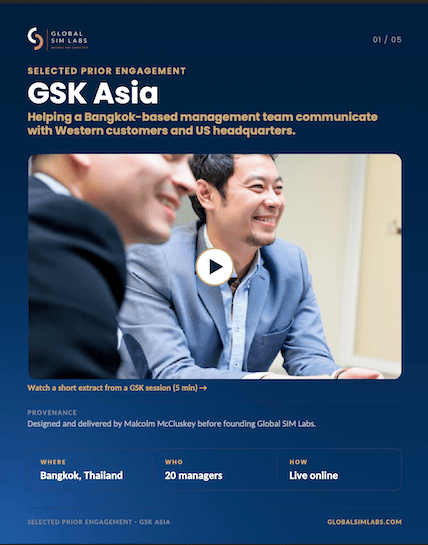
The project preceded GSL
The problem did not.
Before creating Global SIM Labs, Malcolm McCluskey (founder and principal) designed and delivered this work in close collaboration with GSK’s Asian management team. The challenge was practical: helping capable managers make their expertise count with Western customers and with colleagues at US headquarters. Participants ranged from junior managers to senior leaders.
It is the same problem Working with the West addresses today.
The work focused on:
- Stating a position clearly, and standing behind it
- Listening for what was meant, not only what was said
- Building a business case in the order decision-makers expect
- Presenting data so it supports a decision
- Raising concerns with Western counterparts and headquarters
99%+
Participant satisfaction across three measures set before the programme began: impact on learners, participant involvement and programme effectiveness.
Make professional judgement visible - and actionable
Working effectively across Western-influenced organisations requires more than expertise and good intentions.
Strong recommendations can go unheard. Apparent agreement can conceal different expectations. Responsibility can remain unclear, while important risks are raised too late.
Working With the West is a private, 120-minute executive briefing examining five consequential operating demands:
- Clarity — Make the judgement, decision and required action unmistakable.
- Challenge — Raise disagreement in ways that improve decisions.
- Influence — Build support among stakeholders who matter.
- Ownership — Make responsibilities and accountability clear.
- Escalation — Communicate emerging risks while options remain.
The briefing helps leaders recognise where familiar professional expectations may differ, and respond with greater precision when working across Western-influenced environments.
120 minutes · Live online · Up to 25 attendees
US$3,000 per private organisational briefing
Larger groups and substantial tailoring quoted separately.
When one demand needs more depth
Working with the West introduces five operating demands and shows where judgement gets lost inside them. The Applied Business Series takes each demand in turn and puts it into practice — a focused seminar built around one realistic case that develops as the session goes on.
Decision Clarity & Executive Communication · Constructive Challenge & Productive Disagreement · Stakeholder Influence · Ownership, Autonomy & Accountability · Early Warning, Escalation & Recovery
90 minutes · Private to your organisation · Up to 25 attendees · US$3,000 each. Each seminar can be booked on its own, or run as a five-part programme following the flagship briefing.
The briefing ends. The real work doesn’t.
A second opinion when the situation is live and the next move matters.
Confidential support for a live decision, meeting, stakeholder tension or developing risk in Western-influenced systems. Available on its own, with or without a briefing.
Before. Prepare the next move.
As it develops. Re-check as things change.
After. Review what happened and recover.
The decision always stays with you.
Bounded support for important work.
Choose the level of access that fits how often situations arise. Scope, access and fees are agreed before any work begins.
Inside:
- Executive Decision Session · 45 minutes · US$600
- 90-Day Team Advisory · US$4,000
- Six-Month Advisory Partnership · US$8,000
- Annual Advisory Partnership · US$15,000
Prepare your people for the work they are actually facing.
Tell us how your organisation works with Western colleagues, clients, headquarters and decision systems: who needs to be prepared, and what is at stake.
We begin with a 20-minute introductory discussion. There is no charge, and it is not an advisory session. We will suggest the right starting point: the 120-minute Working with the West briefing, an Applied Business Series seminar, Advisory Desk support or TB5™ simulations.
Please do not include confidential information when booking.